
How familiar are you with terms like Beaver Fever, Fisherman’s Dinner, Give ‘er, or Raging Grannies?
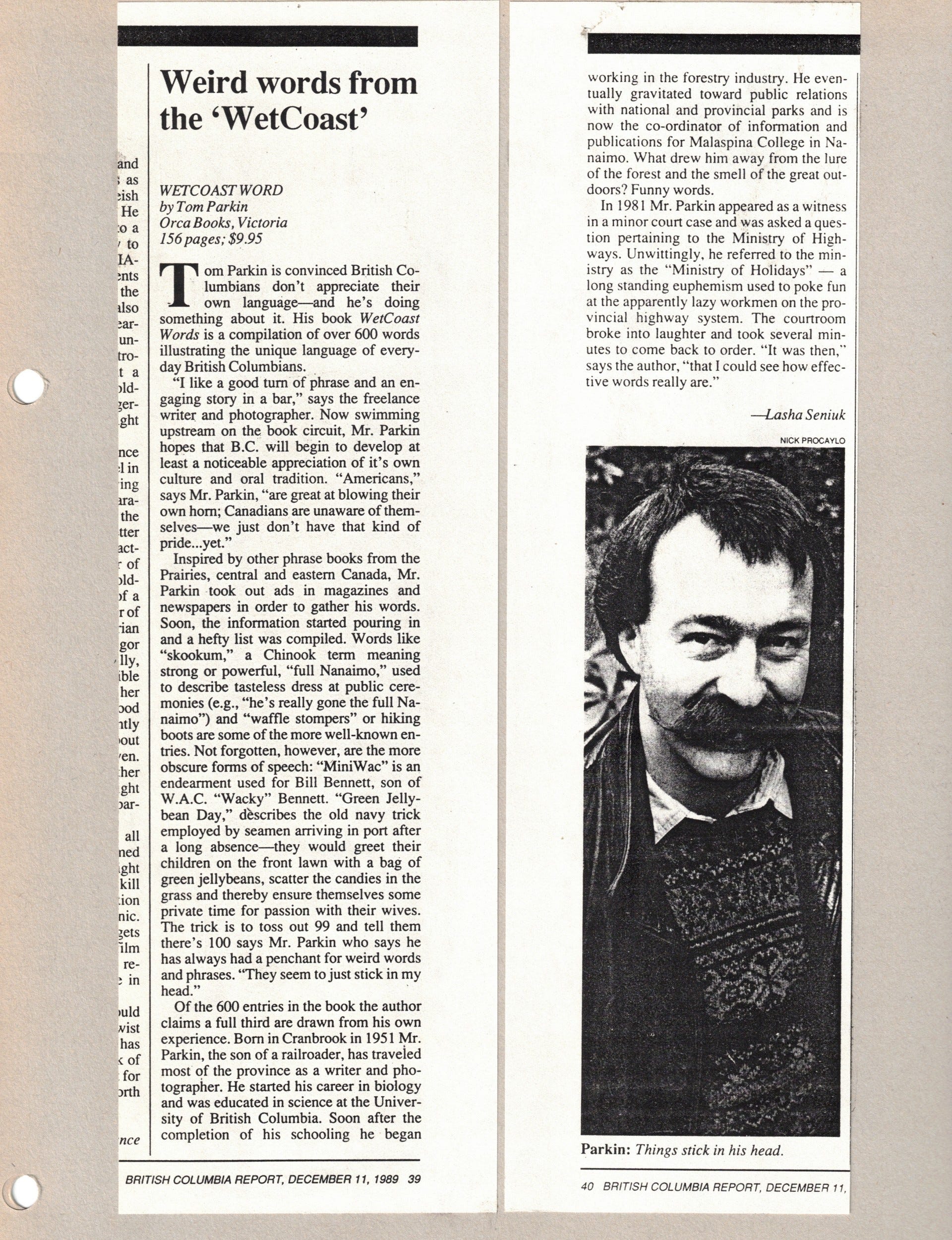
These words, according to author and BC history writer Tom Parkin, have origins in British Columbia. In his 1989 book, Wet Coast Words, Tom outlined over 600 terms that are unique to this province.
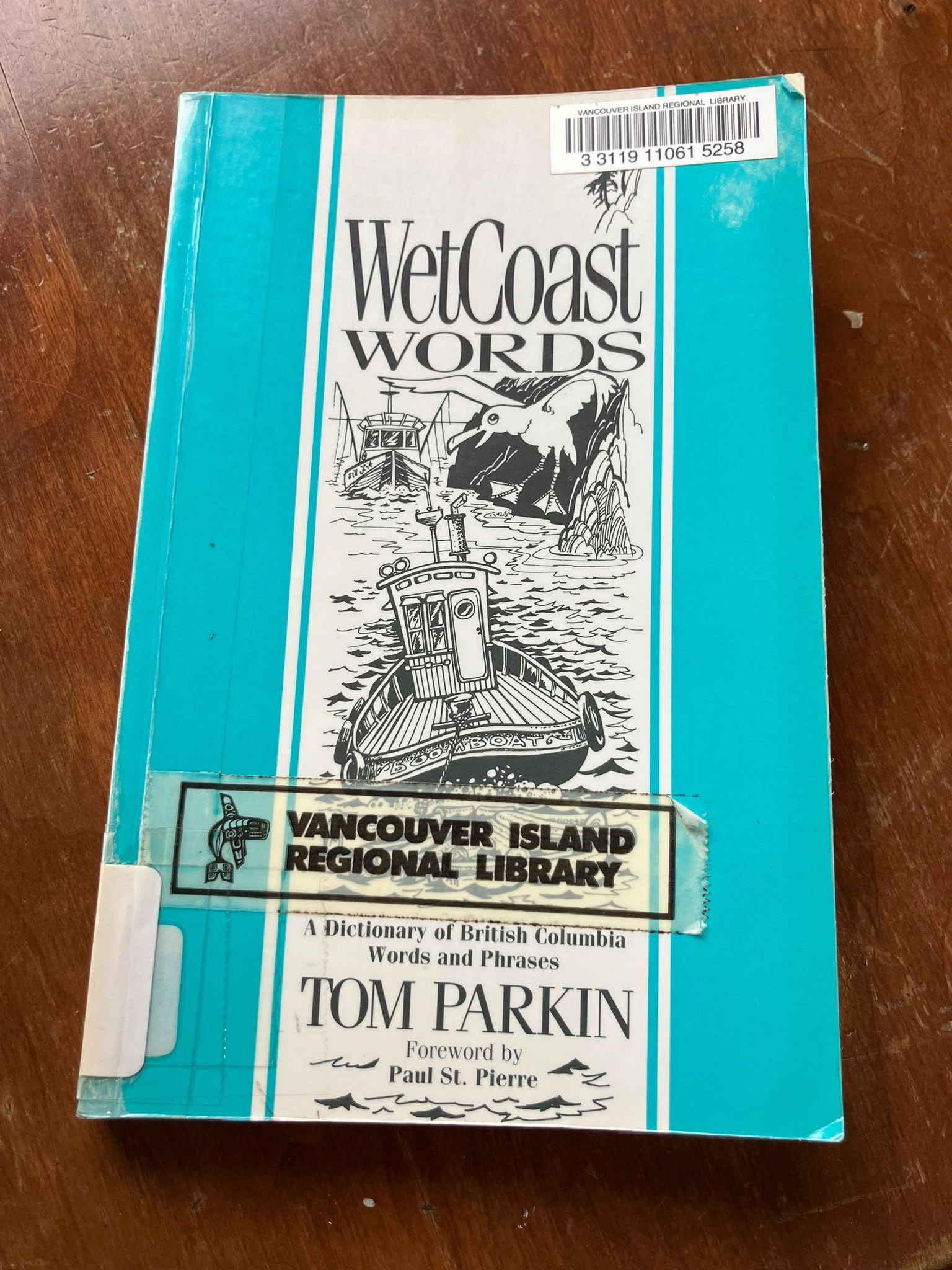
I recently borrowed his classic title from the Vancouver Island Regional Library. At check out the librarian did a double take at the retro artwork. “Wow! This is a really old book to be in the library!”
Given that I was born the year Wet Coast Words was published, some of these terms were mystifying to me (i.e. Raging Grannies), others surprised me, and many more made me laugh (again, Raging Grannies). I had to know more about this book and the terms. So, I called up Tom.
Here’s a lightly edited version of our conversation.
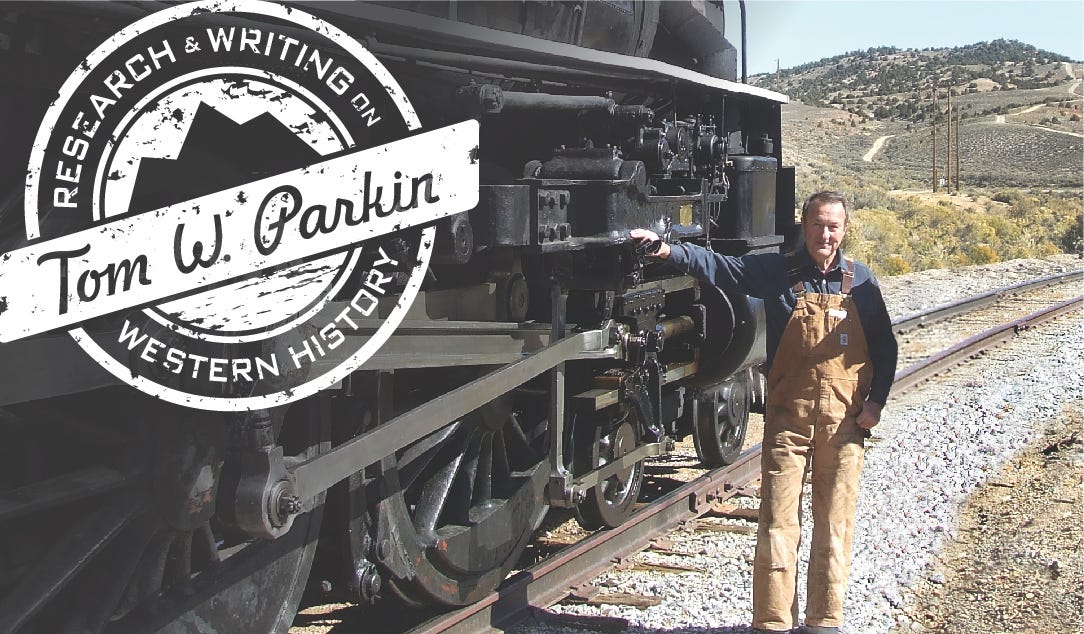
Dave Flawse: What gave you the idea for Wet Coast Words?
Tom Parkin: Similar books have been done for other regions in Canada. I happened across one called Cold as a Bay Street Banker’s Heart. That’s evidently an expression that came out of the prairies, probably during the depression. I thought, what an intriguing title.
For British Columbia, there hadn’t been anything like that, but I knew a handful of words. And then I started publicizing the idea through big media.
I’d be on CKNW radio. I did some small cable TV interviews, lots of interviews with columnists and some book reviewers and said, “Please ask people to call me or write. Do whatever it takes and give me words that they know are British Columbian and whatever they can about their origin.”
Some of the words have actually died out, but they came from all manners of life.
A few of those are Chinook language, which was a trade language you must know. It was used during the fur trade for communication between all of these tribes, all of Cascadia, and the Hudson Bay Company. So, a few of the words remain.
The word chuck, salt chuck, and its variations, skookumchuck, that’s Chinook language. It can be used in a variety of ways and is still recognized in, I would say, most of the coast.
Some of these things stick to their region of the province, and some of them spread widely. They are certainly not held in by any political or geographical boundary.
Skookumchuck
“Strong” and “water,” therefore whitewater rapids, or a powerful tidal current.
From Tom Parkin’s Wet Coast Words published by Orca Book Publishers in 1989
DF: What do you think makes a word stick or not stick?
Well, I can’t answer that with any authority, but what I included in the book, or at least the way I expressed it, was humor.
To say skookumchuck, it’s got a pleasant ring to it in some way. And maybe it expresses a certain amount of characterization of the speaker. Maybe they feel like they’re a character themselves to say that. That they’ve got a unique language. It’s a way that we can distinguish ourselves.
DF: Speaking of humour, tell me about Raging Grannies.
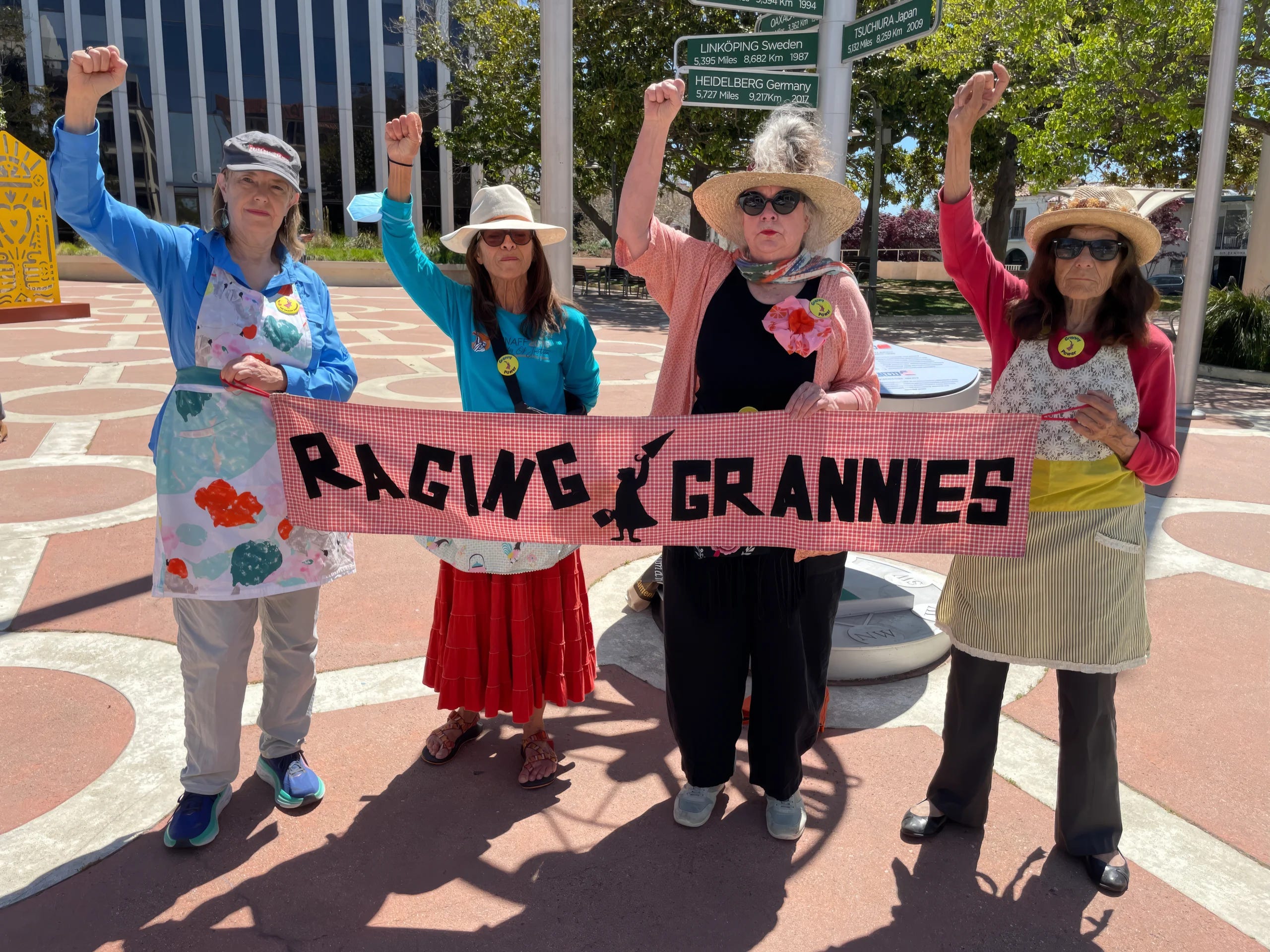
Raging Grannies
Founded at Victoria in February, 1987, this dedicated group of angry ladies now has other provincial chapters. They appear at peace movement and environmental events to sing protest songs of their own composition. Their grassroots movement fights for a safe planet for all children
From Tom Parkin’s Wet Coast Words published by Orca Book Publishers in 1989
TP: You don’t hear about them anymore. I don’t know if they’re still around. They started in Victoria then spread around the province.
[Note: It turns out the Raging Grannies are still active, though no longer on Vancouver Island. They seem to be most active in the United States now.]
As part of the humour of the book, the publisher hired an artist and gave him some of the words, and he put cartoons as he perceived the humor in the phrase or whatever word it was.
And the Raging Grannies were not one of my fans because you look at the cartoon. They’re all looking like banditos hiding in a back alley.
[Note: the illustration depicts two frowning grandmothers. One lady sports a black leather jacket. She grasps numb chuck handles, pulling the chain between them taut. The other wears a feathered beret and eyepatch. In the left hand, she wields a revolver.]
They said, “that’s not who we are at all, and you misportrayed us.”
They didn’t see any humor in it. I don’t know what I said or even if I replied because it wasn’t worth it. But even though the humor is distinct, I guess it was too subtle for them.
DF: Another funny one that popped out to me was fisherman’s dinner. I hadn’t heard that before. Did that one come from your own experience or did someone call it in?
Fisherman’s Dinner
As listed on menus of restaurants in fishing ports, it always means a steak. For some reason, many fishermen hate eating their catch.
From Tom Parkin’s Wet Coast Words published by Orca Book Publishers in 1989
TP: I lived in Northwestern BC at the time of writing and publication. I think I saw that on a menu in Prince Rupert but since as well. You get that in a fishing town such as Prince Rupert or any of the other port communities on the coast.
DF: Let’s switch over to logging, and the term “give ‘er.” I don’t know if you’ve seen the Canadian cult classic movie FUBAR. It’s set in Alberta. I think that movie is where the term was most famously used. I’ve always wondered where it came from. Interesting to hear it potentially came from British Columbia.
Give ‘er
“Give her snoose” (formally in logging), now most frequently modified to “Give ‘er hell.” To fly at it. An expression of enthusiastic employment.
From Tom Parkin’s Wet Coast Words published by Orca Book Publishers in 1989
TP: How these things get started, you know, it’s probably an individual in some cases. I have a buddy that talks gruff, and he uses phrases like this to express his disgust or whatever and some of them I had never heard.
My dad was typical guy of an earlier generation, but he had expressions such as I couldn’t put in the book, but one that I’ve rarely heard: he’d be mad at somebody and he’d say “that man ought to be shot with a ball of his own shit.”
DF: My grandma, she’s in her 90s and grew up on the island. She has so many of those. One that stands out is “Oh, fiddle farts!”
Another one that surprised me as being a BC term was beaver fever. I had assumed it was much more widely used.

Beaver Fever
A term coined by the media in 1981 after a microbe called Giardia lamblia caused several epidemics in Alberta and BC communities. It can cause severe intestinal disorder when ingested, usually by drinking water from reservoirs containing infected wildlife. Since then, wildlife other than beaver have been found to be hosts.
From Tom Parkin’s Wet Coast Words published by Orca Book Publishers in 1989
TP: I don’t know if it was first diagnosed here. I was writing that in the days before Google. I had to do this research just by the old pen and paper routine.
The Canada Diseases Weekly Report, 15 May 1982, vol. 8, no. 20, describes “what local residents have colloquially termed ‘beaver fever’”. That supports my contention of it being coined a year before, but I did not retain my files after the publisher expressed no interest in a second, enlarged, edition.
DF: Any favourite words in the book?
Zunga
How it came to be isn’t known, but for at least 40 years kids in Powell River have used this word to describe a Tarzan swing; a tree rope which hangs over a summer swimming hole. A great word; pity it hasn’t spread more widely.
From Tom Parkin’s Wet Coast Words published by Orca Book Publishers in 1989
TP: Zunga. My favourite word was provided by my wife, who grew up in Powell River in the 1950s. Today it is still used by the City to identify a rope over the pool in the aquatic centre.
DF: Thanks, Tom!
Here’s a list of entries in Wet Coast Words that deserve and honourable mention:
Century Sam
A cartoon prospector created during the province’s 1958 centennial, and who was like and official emblem. Sid Williams of Comox became the embodiment of the character and took part in many celebrations. Williams actually owned a small gold claim and is commemorated by Century Sam Lake at the headwaters of Comox Creek.
Klee Wyck
Emily Carr (1871–1945), BC author and painter, was given this name by [Nuu-Chah-Nulth people]. It means “laughing one,” for her good humour. Carr’s book by this title was published in 1941.
UIC Ski Team [now EI Ski Team]
The former ease of obtaining unemployment enjoyment cheques afforded by many young people the chance to work summers and ski at downhill resorts all winter.
From Tom Parkin’s Wet Coast Words published by Orca Book Publishers in 1989